

American Made Boat Flag Poles: The Standard for High-Speed Marine Performance
Most boat flag poles are designed for the dock, not the open water. If you've ever watched a flag snap at 30 MPH or struggled with a universal mount that rattles against your custom wake tower, you know that generic hardware isn't built for real performance. It's frustrating to invest in a high-end vessel only to have saltwater corrosion destroy your accessories in a single season. We agree that your gear should work as hard as your engine does. This is why serious boaters are turning to custom engineered boat flag poles that prioritize mechanical integrity over mass-market convenience.
In this article, you'll discover why American-made engineering is the only choice for boaters who demand stability in harsh marine environments. We'll show you how precision-fabricated hardware can withstand speeds exceeding 50 MPH without compromising your boat’s aesthetics. We're going to break down the differences between flimsy imports and the specialized craftsmanship required to create a lifetime solution for your wake tower. You'll learn exactly what to look for in a mounting system that stays secure, looks professional, and survives the brutal reality of life on the water.
Table of Contents
The Functional Necessity of American Made Boat Flag Poles
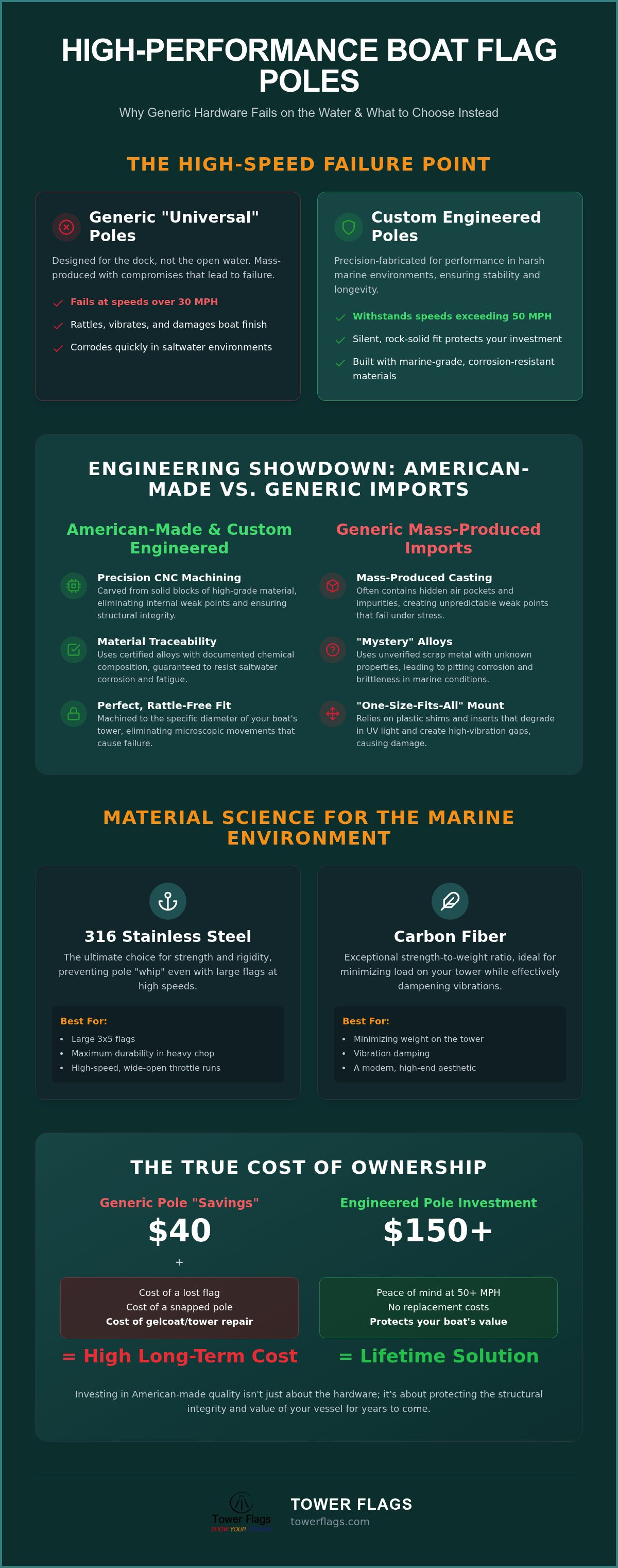
In the marine industry, the "American Made" label represents a functional engineering specification rather than a simple marketing claim. When your vessel reaches cruising speeds, the hardware on your wake tower or rail is subjected to intense physical stress. Choosing custom engineered boat flag poles manufactured domestically ensures that every component meets a strict standard of material traceability. We don't rely on mystery alloys or unverified scrap metal. Instead, domestic fabrication allows for a transparent supply chain where the mechanical properties of the steel or aluminum are documented and guaranteed to withstand the rigors of high-speed transit.
Precision is the primary difference between a component that lasts a decade and one that fails in a month. Domestic manufacturing allows for significantly tighter tolerances than mass-produced imports. When a bracket is machined to within a thousandth of an inch of your tower's specific diameter, the fit is absolute. This eliminates the microscopic movements that lead to hardware failure. By prioritizing these exact specifications, we mitigate high-speed vibration, which is the leading cause of mount fatigue and hardware loss at sea.
Quality Control in Domestic Marine Fabrication
The reliability of American-made hardware starts with alloy traceability. Every batch of metal used in our fabrication process has a certified chemical composition, ensuring it won't become brittle or succumb to "pitting" corrosion in saltwater environments. Unlike mass-produced casting, which often hides internal air pockets and structural weak points, our components are created through precision CNC machining. This process carves the hardware from solid blocks of high-grade material. Tower Flags utilizes this custom fabrication approach to ensure a rattle-free experience. Because the fit is tailored to your specific boat model, there is no gap for wind resistance to exploit, resulting in a silent, rock-solid display even at wide-open throttle.
The Cost of Failure: Why Generic Poles Cost More in the Long Run
The most common objection to premium hardware is the initial investment. However, the true cost of a "universal" mount often includes a lost flag, a snapped pole, and expensive damage to your boat's gelcoat or tower finish. Generic mounts rely on shim kits and plastic inserts that degrade under UV exposure and constant vibration. These failures aren't just inconvenient; they're costly. Our custom engineered boat flag poles are built to exceed 2026 marine performance standards, anticipating the higher speeds and heavier loads of modern powerboats. Domestic engineering reduces material fatigue by ensuring that load distribution remains consistent across the entire mounting surface rather than concentrating stress on a single point of failure. Investing in American-made quality isn't just about the hardware; it's about protecting the structural integrity of your vessel.
Material Science: Engineering for the 2026 Marine Environment
The 2026 marine environment demands more from hardware than ever before. Modern boats are faster, and the sun's UV intensity is increasingly damaging to sub-par materials. When selecting custom engineered boat flag poles, the choice between high-grade stainless steel and carbon fiber dictates how your equipment handles high-speed drag and long-term exposure. Carbon fiber offers an exceptional strength-to-weight ratio, making it ideal for boaters who want to minimize the load on their tower while maintaining extreme rigidity. Conversely, for those flying large 3x5 flags at high RPMs, the sheer mass and stiffness of 316-grade stainless steel provide the necessary structural integrity to prevent excessive whip.
Stainless Steel vs. Carbon Fiber Marine Poles
Choosing the right material depends on your specific performance goals. Carbon fiber is prized for its ability to dampen vibrations, which is a critical factor when mounting to a rigid wakeboard tower. It doesn't fatigue like aluminum, and it offers a modern, high-end look that complements premium boat builds. If you're consistently pushing through heavy chop at 50+ MPH, the structural integrity of a steel pole is hard to beat. You can learn more about these technical trade-offs in our detailed guide on Marine Flag Poles: Engineering for Durability and High-Speed Performance.
UV exposure is a silent killer for many composite materials. Lower-grade carbon fiber poles often use epoxy resins that yellow and become brittle after just one season of direct sunlight. Our American-made engineering utilizes UV-stabilized resins and specialized clear coats to ensure the composite structure remains flexible and strong. For those who prefer a classic, polished look, we recommend our stainless steel flag poles, which are built to withstand both the sun and the spray.
Combating Saltwater Corrosion and Oxidation
Saltwater is a powerful electrolyte that triggers rapid oxidation in inferior metals. To prevent the "tea staining" and pitting common in mass-produced imports, we use passivated 316 stainless steel. Passivation is a chemical process that removes free iron from the surface of the metal, creating a protective oxide layer that's virtually impervious to the spray zone. This isn't just about looks; it's about preventing crevice corrosion that can weaken the base of the pole. High-quality custom engineered boat flag poles require significantly less maintenance, usually needing only a fresh-water rinse to stay in showroom condition for years. This level of chemistry ensures your hardware remains a permanent fixture on your boat rather than a seasonal replacement expense.
Custom vs. Universal: Why Precision Fit Matters
Universal mounts are marketed as a convenient solution for the average boater, but they represent a compromise that high-performance vessels can't afford. A "one-size-fits-all" approach typically relies on rubber inserts or plastic shims to bridge the gap between a generic bracket and your boat’s hardware. These materials are the first points of failure. Under the constant tension of a flag at cruising speeds, these shims compress and shift. When you're running at 40 MPH, even a millimeter of play in the mount creates a rhythmic vibration that travels through the entire structure. Custom engineered boat flag poles eliminate this mechanical failure point by utilizing brackets machined to the exact specifications of your vessel.
Aesthetics also play a significant role in the choice between custom and generic hardware. Universal clamps are often bulky, featuring protruding bolts and oversized housings designed to accommodate a wide range of pipe sizes. They break the sleek, intentional lines of a modern boat. In contrast, custom-integrated hardware offers a streamlined profile. Because the fit is exact, the bracket requires less physical mass to maintain its grip, resulting in a cleaner look that appears to be a factory-installed component rather than a clunky after-market addition.
The Danger of Universal Rod Holder Mounts
A common mistake is attempting to use a universal rod holder mount to fly a large flag. Unlike a fishing rod, which experiences intermittent tension, a flag at high speeds generates constant, high-frequency drag. In a loose or poorly fitted mount, this drag translates into a hammer-like vibration. Over time, this oscillation can lead to stress fractures in the boat hull or loosen the mounting bolts on your rail system. "Universal" often means it doesn't fit anything perfectly. We've documented these risks extensively in our Ultimate Guide to Custom Boat Flag Brackets 2026, which outlines why precision is the only way to protect your boat's finish.
Engineering for Wakeboard Towers
High-performance wakeboard towers, such as the Malibu G3 or similar specialized designs, are engineered for specific weight and pull ratios. Attaching a generic, poorly fitted clamp can mar the expensive powder coat and apply uneven pressure to the tower’s tubing. We specialize in custom engineered boat flag poles and brackets that match the exact outer diameter (OD) of your specific tower. This precision ensures that the load is distributed evenly across the metal surface, preventing the "crimping" effect that can permanently damage the tower's structural integrity. Our fabrication process involves mapping the geometry of specific tower models, ensuring that the hardware seats perfectly without the need for destructive tightening or unreliable spacers.
Selecting Your American Made Boat Flag Pole
Selecting the right hardware is a technical process that goes beyond simple aesthetics. It's a calculation of wind load, mounting geometry, and material strength. When you invest in custom engineered boat flag poles, you're ensuring that the hardware is matched to the specific mechanical demands of your vessel. You need to account for your typical cruising speed and the surface area of the flag you intend to fly to prevent hardware failure at high RPMs.
Measuring for Custom Marine Brackets
Achieving a rock-solid fit starts with an accurate measurement of your tower or rail. Because our brackets are machined to tight tolerances, a generic guess won't suffice. Follow this checklist to ensure your hardware fits perfectly:
Use digital calipers: Measure the outer diameter (OD) at your exact mounting point for the most accurate reading.
Use the string method: If calipers aren't available, wrap a non-stretch string around the pipe, measure its length, and divide by 3.14 to find the diameter.
Clearance check: Verify that the mounting area is clear of bimini hardware, tow ropes, and navigation lights.
In the world of custom marine fabrication, we live by a simple rule: measure twice, fabricate once. A precision measurement ensures the bracket grips the metal without the need for unreliable rubber spacers or shims that degrade over time.
Matching Pole Strength to Flag Size
The physics of a flag change dramatically as you accelerate. A 12x18 inch flag creates manageable drag at most speeds, but a larger 3x5 foot flag at 40 MPH generates significant force. This is why selecting a heavy duty boat flag pole is critical for high-speed performance. A thicker-walled pole prevents the "whip" effect that leads to metal fatigue or bracket failure. For performance vessels running at 50+ MPH, we recommend keeping the pole length as short as visibility allows. This reduces the leverage wind has on the mounting point and keeps the display stable. Explore our selection of heavy-duty poles and custom brackets to find the right fit for your speed.
The Tower Flags Difference: Custom Fabrication for Boaters
Tower Flags operates as a dedicated workshop rather than a mass-market retailer. We've built our reputation on the specific needs of boaters who are tired of replacing broken hardware every season. When you order from us, you aren't pulling a box off a shelf; you're initiating a precision fabrication process. Each of our custom engineered boat flag poles is built to order, ensuring that the hardware you receive is a direct match for your boat's specific geometry. This direct-to-consumer model allows us to maintain a level of quality control that is simply impossible for generic imports to replicate.
Owning American-made hardware brings a sense of pride that comes from knowing your equipment won't fail when the throttle is down. We believe in a "buy it once" philosophy. While generic poles are often treated as disposable accessories, our hardware is designed to be a permanent part of your vessel's profile. There is a fundamental relief in finding a specialized product that finally eliminates the rattle and vibration common with inferior gear.
Bespoke Marine Engineering
Working with a dedicated specialist means your flag hardware is designed with a deep understanding of mechanical stress and fluid dynamics. We don't just make brackets; we engineer solutions that protect your boat. High-end vessels maintain their resale value when they are equipped with hardware that matches their original build quality. Prospective buyers recognize the difference between a clunky universal clamp and a streamlined, custom-fabricated mount. This attention to detail signals that the boat has been maintained to a professional standard, turning a simple flag display into a mark of overall vessel integrity.
Securing Your Display for 2026 and Beyond
As boat designs evolve toward more aggressive tower profiles and higher cruising speeds, our fabrication methods stay ahead of the curve. We anticipate the needs of the 2026 boating season by using materials that resist the increased UV and chemical exposure of modern waterways. Before you head out for your first run of the year, use this checklist to ensure your display is ready:
Inspect the bracket mounting bolts for any signs of loosening from off-season vibration.
Check the flag attachment clips for smooth mechanical operation and spring tension.
Wipe down the pole with a fresh-water cloth to remove any salt residue or dust from storage.
Verify that your custom engineered boat flag poles are seated fully in their brackets without any play.
Your boat represents a significant investment in your lifestyle. The hardware you choose to display your flag should reflect the same level of quality and performance as the boat itself. By choosing custom fabrication, you're choosing reliability that lasts for the lifetime of your vessel.
Equip Your Vessel for High-Speed Performance
Your boat is a high-performance machine, and every accessory should match that engineering standard. We've explored how domestic manufacturing ensures material traceability and why universal mounts simply can't handle the intense drag of open-water cruising. Choosing custom engineered boat flag poles is the only way to eliminate the vibration and structural stress that lead to gear loss and tower damage. You're investing in a specialized solution that is custom-fabricated for a perfect fit on your specific wake tower or rail system.
Our hardware is rigorously tested for high-speed marine performance, ensuring your display remains stable at 50+ MPH. It's time to stop settling for generic hardware that rattles, corrodes, or snaps under pressure. You've invested in a premium vessel; it deserves hardware that reflects that level of quality and craftsmanship. Shop Precision-Engineered American Made Boat Flag Poles today to secure a display built with 100% American-made quality. Enjoy the relief of knowing your gear is as reliable as your engine. We'll see you out on the water.
Frequently Asked Questions
Are American made boat flag poles really stronger than imported ones?
Yes, American-made poles provide superior strength because they utilize documented alloys and precision CNC machining. Many imports rely on inferior casting methods that hide internal air pockets and structural flaws. By choosing custom engineered boat flag poles made domestically, you ensure the hardware meets strict material traceability standards. This level of quality control prevents the sudden mechanical failures often seen in mass-produced alternatives when cruising at high speeds.
What is the best material for a boat flag pole for high speeds?
316-grade stainless steel and high-modulus carbon fiber are the top choices for high-speed performance. Stainless steel offers the mass and stiffness required to fly large 3x5 flags without excessive whip. Carbon fiber provides an exceptional strength-to-weight ratio and naturally dampens vibrations. Both materials are engineered to withstand the extreme drag forces generated at 50 MPH, provided they are paired with a precision-fit mounting system.
Can I mount a flag pole on my wakeboard tower without drilling?
You can absolutely mount a flag pole without drilling by using custom-fit brackets designed specifically for your tower's diameter. These brackets utilize a high-friction clamping force that secures the hardware without damaging the tower's powder coat or structural integrity. Unlike universal mounts that require unreliable shims, these custom engineered boat flag poles stay rock-solid through precise machining, ensuring a permanent fit that remains completely non-destructive to your vessel.
What flag size is recommended for a 4-foot marine flag pole?
A 2x3 foot or 3x5 foot flag is standard for a 4-foot marine pole. Keep in mind that a 3x5 flag creates significantly more drag at cruising speeds than a smaller 12x18 inch version. If you plan on running at speeds over 40 MPH, ensure your pole and bracket are rated for the increased leverage. A heavy-duty pole is essential when flying larger flags to prevent metal fatigue over time.
How do I prevent my boat flag pole from rattling at high speeds?
Eliminating rattles requires a precision fit between the pole, the bracket, and the boat tower. Most noise comes from the gaps found in "universal" hardware that uses plastic inserts or rubber shims. These materials compress over time, leading to loose connections. By switching to custom-fabricated hardware machined to your tower's exact outer diameter, you remove the mechanical play that causes vibration and noise during high-speed transit.
Do I need a special marine flag pole socket for saltwater use?
Saltwater environments require a passivated 316-grade stainless steel socket to prevent pitting and crevice corrosion. Standard hardware often uses 304-grade steel or unpassivated alloys that rust quickly in the spray zone. A dedicated marine socket ensures that the iron is chemically removed from the surface, leaving a protective oxide layer. This level of material science is a standard feature in high-quality American-made marine accessories.
How much wind speed can a heavy duty boat flag pole handle?
High-quality heavy-duty poles are typically tested to handle combined wind and boat speeds exceeding 50 MPH. The actual capacity depends on the flag's surface area and the rigidity of the mounting bracket. While generic poles might snap at 30 MPH, precision-engineered hardware is built to survive modern powerboat performance. Always check the specific speed rating for your pole and flag combination before pushing your vessel to its limit.
Is carbon fiber better than stainless steel for marine flag poles?
Carbon fiber is better for boaters who want to minimize weight on their wake tower while benefiting from superior vibration damping. It doesn't fatigue like aluminum and offers a modern aesthetic. Stainless steel is the better choice for those who prefer a traditional polished look and the maximum stiffness needed for very large flags. Both materials offer excellent longevity if they are manufactured to high-performance marine standards.


Comments