

Choosing the Right Marine Flag Pole Socket for Durability and Performance
Most boaters treat a marine flag pole socket as a simple piece of decorative trim, but at 40 mph, that decoration becomes a critical mechanical failure point. It's a frustrating reality when hardware chosen for its look fails to meet the physical demands of the open water. You've likely experienced the disappointment of a cheap, chrome-plated mount pitting and peeling after a single season, or the anxiety of watching your flag pole wobble violently as you pick up speed. You need hardware that performs as well as it looks, regardless of the conditions.
We understand that you want a mount that stays rock-solid without compromising your vessel's finish. This guide explains how to select a marine flag pole socket that withstands high-velocity wind loads and harsh salt air while ensuring your flag remains securely attached during fast transits. We'll examine the importance of material selection for long-term durability, the necessity of matching specific hull or tower angles for a professional fit, and why precision-engineered hardware is the only way to guarantee mechanical integrity. By the end, you'll have the technical knowledge to choose a mounting solution that survives the elements indefinitely.
Table of Contents
Understanding the Role of a Marine Flag Pole Socket
A marine flag pole socket is a precision-engineered receiver designed to distribute wind load across the boat’s deck or rail. It serves as the primary anchor point between your vessel and your flag staff, acting as the critical interface where mechanical stress meets your boat's structure. While some retailers treat these as simple decorative accessories, they're actually structural components that must manage the immense leverage created by wind resistance against the flag’s surface area. If the socket isn't up to the task, the resulting vibration can lead to "pole chatter," a repetitive impact that can damage expensive fiberglass gelcoats or even cause the hardware to rip free entirely.
Choosing the right hardware requires a solid understanding of how these forces interact with your boat. You can consult a Glossary of nautical terms to better understand the relationship between your vessel's rake, deck layout, and mounting points. Ultimately, a quality marine flag pole socket is about more than just holding a staff; it's about protecting the integrity of your vessel while maintaining a professional appearance at any speed.
Why Generic Hardware Fails at Sea
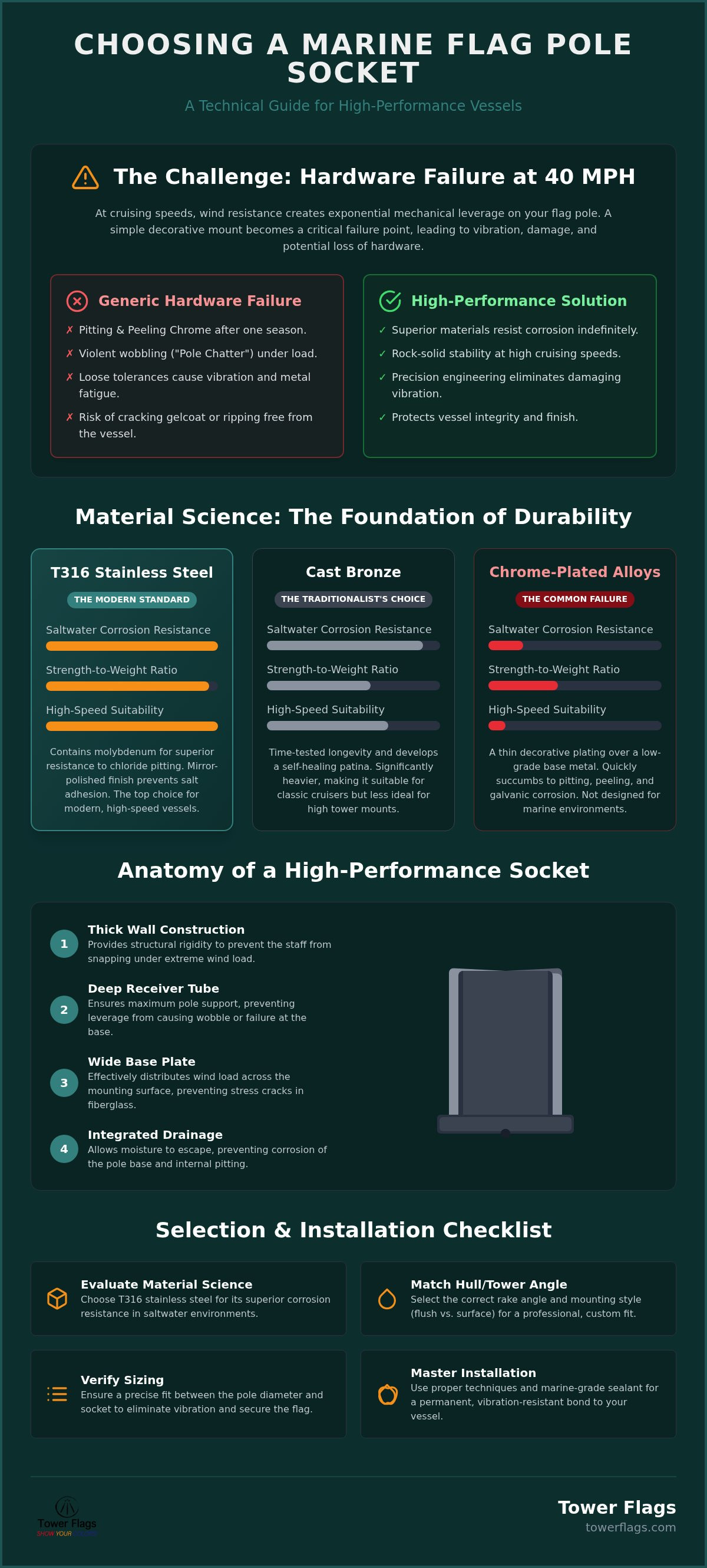
Generic sockets are often a major source of frustration for boaters because they're designed for stationary use rather than the rigors of the open water. These mass-produced parts often utilize low-grade alloys that succumb to galvanic corrosion within a single season. The loose tolerances found in generic manufacturing create a gap between the pole and the socket, leading to excessive vibration. This slop eventually causes the metal to fatigue and fail. While a generic mount might look fine at the dock, it rarely survives the dynamic loads and high-speed cruising that modern vessels are built for.
The Anatomy of a High-Performance Socket
A high-performance marine flag pole socket is built with specific mechanical features that ensure longevity. The wall thickness and the total depth of the receiver tube are the most important factors, as they dictate the maximum pole height allowed and prevent the staff from snapping under pressure. The base plate's dimensions are also vital. A wider base plate dictates how effectively the wind load is distributed across the mounting surface, preventing stress concentrations that lead to cracks. Additionally, precision-engineered sockets include drainage holes. These allow moisture to escape, preventing standing water from corroding the pole base or causing internal pitting within the socket itself.
Material Science: Stainless Steel vs. Bronze vs. Chrome
Corrosion resistance isn't optional; it's the baseline for any marine hardware selection. When you choose a marine flag pole socket, you're choosing a component that will live in a constant cycle of salt spray and UV exposure. Materials must be non-reactive to prevent galvanic corrosion, which can lead to permanent staining or structural damage on your boat’s mounting surface. Weight-to-strength ratios are equally vital. Hardware located high on towers or rails needs to be lightweight enough to avoid affecting the vessel's center of gravity while remaining strong enough to handle extreme wind leverage. Tower Flags prioritizes high-integrity materials that match the engineering of our marine flag poles to ensure a unified, fail-safe system.
T316 Stainless Steel: The Modern Standard
T316 stainless steel is the preferred material for high-performance boating environments. Unlike the more common T304 alloy, T316 contains molybdenum. This specific addition significantly increases the metal's resistance to chloride pitting and crevice corrosion in salt water. A mirror-polished finish on a stainless marine flag pole socket does more than just look professional. It smooths the microscopic surface of the metal, reducing the areas where salt crystals can bond and cause oxidation. This material provides the structural rigidity required for boats that regularly cruise at high speeds, meeting the rigorous hardware standards suggested by the American Boat and Yacht Council (ABYC).
Cast Bronze: The Traditionalist’s Choice
Cast bronze is a time-tested material known for its exceptional longevity in the harshest marine conditions. It offers a natural resistance to the elements and develops a "self-healing" patina that protects the underlying metal from further decay. However, bronze is significantly heavier than modern stainless steel alloys. This makes it a beautiful choice for classic timber vessels or heavy cruisers where the weight is less of a concern, but it may not be the ideal fit for lightweight aluminum towers or speed-focused hulls where every ounce matters.
The Trap of Chrome-Plated Zinc
Many boaters fall into the trap of purchasing "pot metal" or chrome-plated zinc sockets because they look identical to stainless steel on the shelf. These are the leading cause of hardware failure. Once the thin chrome plating is scratched or breached, the underlying zinc begins to pit and crumble almost immediately. This process compromises the structural integrity of the mount, often leading to a snapped socket during a high-speed run. While these parts are cheaper initially, replacing them every two years is far more expensive than investing in a quality flag pole bracket that lasts for the life of your boat.
Mounting Styles and Geometry: Flush vs. Surface Mounts
Selecting a marine flag pole socket requires more than choosing a material. You must consider the specific geometry of your vessel. Whether you mount to the stern, a rail, or a tower, the location dictates the socket's physical footprint. Proper placement ensures the flag flies clear of outboard engines, bimini tops, and fishing lines. For those dealing with complex tower geometries or unconventional angles, custom boat flag brackets provide a specialized solution that generic hardware simply can't match. Every mounting decision should prioritize both the aesthetic flow of the boat and the mechanical stability of the hardware.
Flush Mount Sockets: The Clean Aesthetic
Flush mounts are the preferred choice for boaters seeking a streamlined, professional look. They sit level with the deck, which effectively eliminates trip hazards and prevents fishing lines from snagging on protruding hardware. However, installation is more involved than surface alternatives. You must verify that you have sufficient internal clearance for the socket tube beneath the mounting surface before drilling. To ensure a permanent bond, it's vital to use high-grade marine sealants around the flange to prevent water intrusion. Crucially, a flush-mounted marine flag pole socket should always be installed with a backing plate. This distributes the mechanical stress across a larger area of the fiberglass, preventing the spider cracks in the gelcoat that often plague poorly installed generic mounts.
Surface and Rail Mounts: Versatility and Ease
Surface mounts are ideal for locations where behind-panel access is restricted, making them a practical choice for retrofitting. Rail-mounted sockets offer even more flexibility, allowing you to position your flag on T-tops or bow rails without drilling permanent holes into your deck. When selecting a rail mount, look for "no-slip" gaskets. These are essential for preventing the socket from rotating under the heavy wind load of a 40+ mph run. These mounting styles are often preferred for seasonal displays or when you need the ability to move the flag location based on your current activity, such as fishing or entertaining.
Calculating the Rake and Angle
The rake angle is the degree of offset from vertical, and it directly affects both visibility and performance. Choosing the wrong angle can lead to the flag wrapping around the staff or obstructing your view. Common options include:
Vertical (0-degree): Best for center consoles or high-point tower mounts where clearance isn't an issue.
10-degree: Provides a slight lean that helps the flag catch the wind without wrapping around the staff during low-speed idling.
30-degree: The standard for stern mounts, ensuring the flag stays well clear of the engine cowling and transom.
Matching the socket angle to the hull’s natural lines creates a custom-fabricated look. It's the difference between a piece of hardware that looks like an afterthought and one that feels like an integrated part of the boat's design. This attention to detail ensures your vessel maintains its premium appearance while performing reliably in any conditions.
Sizing and Selection Guide for High-Speed Vessels
Speed transforms a simple flag into a powerful sail. As vessel velocity increases, the wind load on the flag surface area doesn't just grow; it compounds exponentially. A marine flag pole socket must act as a rigid stabilizer for this force, absorbing the torque generated by the staff. Boaters using custom engineered boat flag poles must ensure their socket matches the pole’s performance rating. Using a high-performance pole in a low-rated, generic socket is a recipe for catastrophic hardware failure. It's the equivalent of putting budget tires on a supercar.
Speed Ratings and Mechanical Stress
Standard sockets often fail at speeds exceeding 30 knots because they lack the mechanical depth to counteract the leverage of the staff. High-speed performance requires a deeper receiver and the inclusion of set screws or locking pins. These features prevent the pole from vibrating loose or ejecting under pressure. Proper vibration dampening is also essential. A precision fit ensures the pole doesn't act as a lever against the hull. This prevents the fiberglass fatigue and gelcoat cracking discussed in previous sections, ensuring your boat remains in showroom condition even after years of heavy use.
Matching Socket to Pole Diameter
Marine standards typically fall into 3/4", 1", and 1-1/4" sizes. While 1" is common for many recreational boats, modern performance vessels and wake towers often require 1-1/4" hardware to maintain stability at 40+ mph. A "snug fit" is more important than the material itself when it comes to longevity. If there's even a fraction of an inch of "slop" in the fit, the wind will use that gap to hammer the socket until it cracks. Avoid using bushings or adapters whenever possible. While they seem like a quick fix, they introduce another failure point and reduce the mechanical integrity of the mount. It's always better to buy the correct size for your specific pole diameter from the start.
The relationship between flag size and socket depth is often overlooked by casual boaters. A larger flag generates significantly more drag, requiring a deeper socket to distribute the load effectively across the base. If you're planning on flying a large ensign while cruising at high speeds, verify that your hardware can handle the specific torque. For those who demand total reliability at full throttle, investing in a precision-machined flag pole bracket is the only way to ensure your hardware stays attached. Total confidence at speed comes from knowing every component in your setup is engineered for the task.
Installation Best Practices for a Permanent Bond
A marine flag pole socket is only as reliable as the surface it's attached to. Even the most robust hardware can fail if the mounting area isn't reinforced. High-integrity hardware requires an installation process that prioritizes load distribution and mechanical stability. When you install a socket, you're creating a permanent interface between your boat's structure and the dynamic forces of the open water. Doing it right the first time prevents costly repairs to your fiberglass and ensures your flag remains secure at any speed.
The Backing Plate: A Non-Negotiable Step
Mounting directly to fiberglass is a common mistake that leads to spider-cracking and eventual structural failure. This occurs because the concentrated "pull" of the flag at high speeds exerts immense leverage on a very small area. Using a backing plate is a non-negotiable step for a professional-grade installation. G10 composite plates are excellent for their high strength-to-weight ratio and total corrosion resistance, while stainless steel plates offer maximum rigidity. By distributing the mechanical stress across a larger surface area, you protect your boat’s gelcoat and ensure the marine flag pole socket remains rock-solid during fast transits.
Sealing and Bedding the Hardware
Properly sealing and bedding the hardware prevents moisture from reaching the core of your deck or transom. Choose a high-grade marine sealant based on whether you want a permanent or semi-permanent bond. Before you drill, use the "countersink" trick: run your drill in reverse for a moment or use a countersink bit to chamfer the edge of the hole. This prevents the gelcoat from chipping when the drill bit or the threads of the fastener catch. When it comes to torque, precision is key. Over-tightening can crush the fiberglass core or strip the threads, while loose hardware allows for vibration that leads to fatigue. Follow the specific torque specifications for your fasteners to maintain a secure, vibration-resistant fit.
Routine Maintenance for Marine Hardware
Routine maintenance ensures your hardware remains functional and rust-proof for years. For salt water boaters, a freshwater rinse after every outing is mandatory to remove salt crystals that cause pitting. Periodically inspect the area under the mounting flange for "crevice corrosion," which occurs when oxygen is restricted in the presence of stagnant salt water. It's also wise to replace fasteners every few seasons to prevent them from seizing in the socket. This proactive approach preserves the mechanical integrity of your setup and keeps the hardware looking professional.
Tower Flags serves as the dedicated partner for boaters who refuse to settle for generic, mass-produced alternatives. We focus on American-made quality and custom-engineered solutions that prioritize mechanical integrity. When you choose our hardware, you’re investing in a specialized product designed by craftsmen who understand the unique demands of the marine environment. We provide the rock-solid mounts you need so you can focus on the water, not your hardware.
Secure Your Flag for the Open Water
Selecting a marine flag pole socket is a decision that impacts the longevity of your hardware and the structural health of your boat. You've learned that material science, precision geometry, and reinforced installation are the three pillars of a secure mount. It's the difference between a flag that flies proudly at 40 mph and one that becomes a liability the moment you leave the dock. By choosing high-integrity T316 stainless steel and utilizing professional backing plates, you ensure your vessel remains in showroom condition while handling extreme wind loads.
Upgrade your vessel with precision-engineered flag hardware from Tower Flags. Our products are custom-engineered for high-speed marine performance and feature durable, American-made fabrication. We provide specialized mounting solutions for modern boat towers that generic, mass-produced alternatives simply can't match.
Step onto your deck with the confidence that your hardware is as capable as your vessel. Your flag is a symbol of your pride on the water; make sure its anchor is built to last. Enjoy the peace of mind that comes from hardware designed by specialists who prioritize mechanical integrity above all else.
Frequently Asked Questions
What is the best material for a marine flag pole socket in salt water?
T316 stainless steel is the superior choice for salt water environments because it contains molybdenum to resist chloride pitting. While bronze is a traditional alternative, T316 offers a higher strength-to-weight ratio for performance vessels. Mirror-polished finishes further protect the metal by reducing the surface area where salt crystals can bond. Avoid chrome-plated zinc at all costs; it'll pit and fail within a single season of exposure.
Can I mount a flag pole socket to a wakeboard tower?
You can mount a flag pole socket to a wakeboard tower, but you must use specialized brackets designed for specific tube diameters. Avoid generic "universal fit" hardware that relies on rubber shims, as these often rotate or slip at high speeds. Tower Flags specializes in custom-fabricated brackets that provide a mechanical lock on the tower. This ensures your flag remains vertical and secure even when the boat is operating at full throttle.
How do I know what size flag pole socket I need?
Determine your required size by measuring the outside diameter of your flag staff. Most high-performance marine flag pole socket options are designed for 1-inch or 1-1/4-inch poles. If you're flying a large ensign or cruising at speeds above 30 knots, the 1-1/4-inch standard is recommended for its increased structural rigidity. Always verify that the socket depth is sufficient to support at least four to six inches of the pole’s base for maximum leverage control.
Do I need a backing plate for my boat flag mount?
You absolutely need a backing plate when mounting a socket to a fiberglass surface. Fiberglass is strong but brittle; the leverage generated by a flag at speed creates a "pulling" force that can easily rip through a standard deck. A backing plate made of G10 composite or stainless steel distributes this mechanical stress across a wider area. This prevents spider-cracking in the gelcoat and ensures the mounting hardware remains permanently attached to the hull.
What angle should my boat flag pole socket be?
The ideal angle depends entirely on the mounting location and your boat’s lines. Stern mounts typically utilize a 30-degree rake to ensure the flag clears the engines and transom. For tower or T-top mounts, a 0-degree or 10-degree offset is preferred to keep the flag visible and prevent it from wrapping around the tower structure. Matching the socket angle to the natural rake of your hull results in a professional, custom-fabricated appearance.
Will a 1-inch flag pole fit in a 1-inch socket?
A 1-inch flag pole is engineered to fit a 1-inch socket, but the quality of the fit depends on manufacturing tolerances. Precision-engineered hardware ensures a snug interface that eliminates the "slop" found in mass-produced alternatives. If the fit is too loose, the pole will vibrate. This causes it to act as a hammer against the socket walls. High-integrity marine hardware maintains tight tolerances to prevent mechanical wear and ensure the staff stays seated.
How do I stop my flag pole from vibrating in the socket at high speeds?
Preventing vibration requires a combination of a precision-fit marine flag pole socket and a mechanical locking mechanism. Most high-performance sockets utilize integrated set screws or locking pins to secure the staff in place. This eliminates the "chatter" that occurs when wind loads shift at high speeds. Ensuring your mounting surface is reinforced with a backing plate also prevents the entire assembly from vibrating against the deck, which protects your boat’s finish.
Is it better to have a flush mount or a surface mount socket?
Choosing between a flush mount and a surface mount depends on your aesthetic goals and installation access. Flush mounts provide a clean, professional look and eliminate trip hazards or line snags on the deck. However, they require internal clearance and more complex drilling. Surface mounts are easier to retrofit in locations with restricted behind-panel access. Regardless of the style, prioritize a marine flag pole socket made from T316 stainless steel to ensure long-term durability.


Comments