

How to Install a Vibration-Resistant Boat Tower Flag Pole Clamp: 2026 Guide
Most boat owners accept a speed penalty where they feel forced to strike their colors the moment they throttle up past 20 knots to prevent hardware failure. It's a common frustration to watch a generic bracket slip or hear the constant metallic rattle of a loose pole vibrating against an expensive wakeboard tower. You've invested significantly in your vessel's aesthetics and performance, so your hardware should match those exacting standards. Finding a truly vibration resistant boat flag mount shouldn't feel like a compromise between showing your pride and protecting your tower's powder-coat finish.
This 2026 guide will help you master the technical nuances of securing marine flags for high-speed runs. We'll show you how to achieve a rock-solid display even at 40+ knots while ensuring zero damage to your tower. We'll walk through the precision installation process, from selecting 316L stainless steel components to mastering the mechanical clamping force required for harsh saltwater environments. By the end of this article, you'll have the expertise to install a specialized mounting system that remains silent and secure regardless of the conditions on the water.
Table of Contents
The Physics of Boat Tower Vibration and Drag
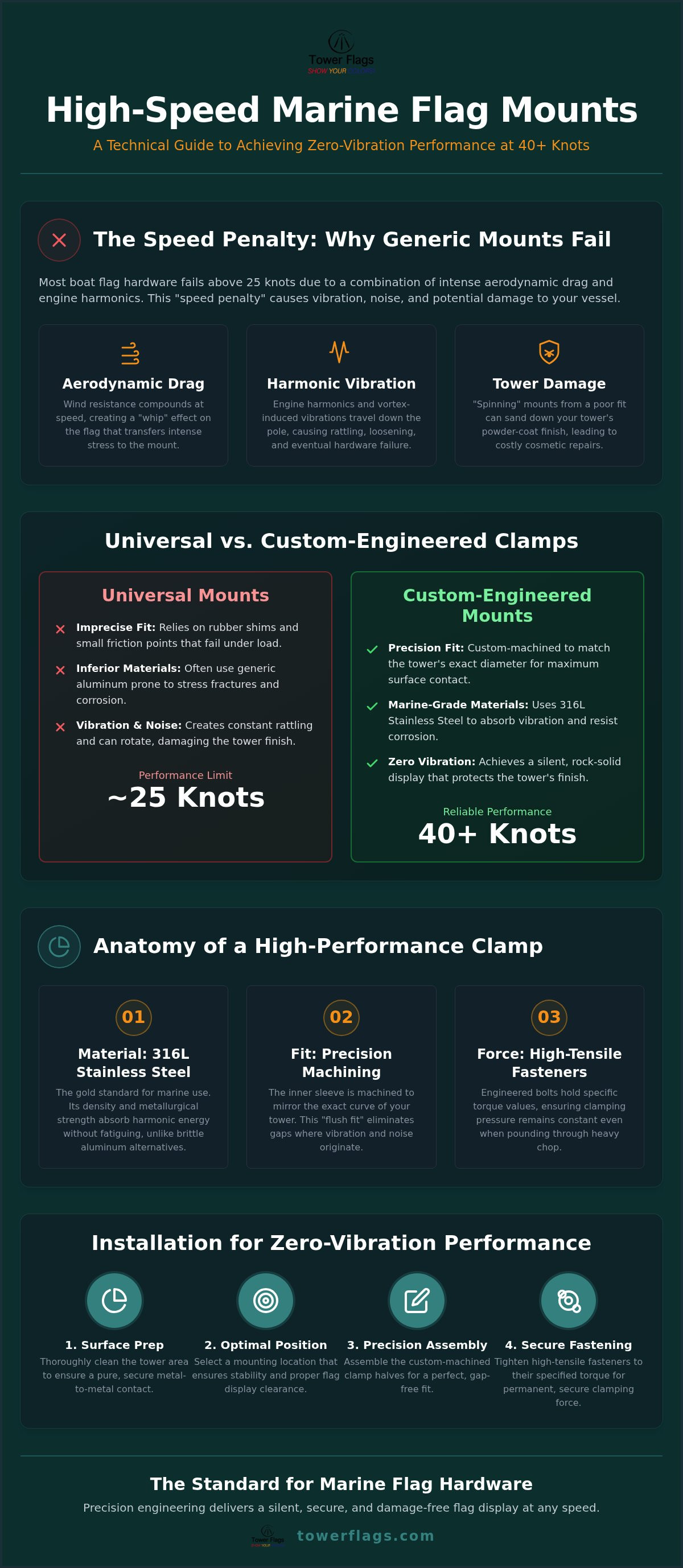
Boat tower vibration represents more than just a nuisance. It's a specific mechanical oscillation caused by a combination of engine harmonics and intense aerodynamic drag. When your vessel is underway, the wind doesn't just push against the flag; it creates Vortex-induced vibrations that travel down the pole and into the bracket. This harmonic stress tests every millimeter of the mounting interface. Without a precision fit, these oscillations quickly translate into audible noise and physical movement.
The "Speed Penalty" is a physical reality where wind resistance doesn't increase linearly; it compounds significantly once you exceed 25 knots. At these speeds, a standard mount often fails because it lacks sufficient surface-area contact with the tower. Instead of a firm grip, generic accessories often rely on small friction points that eventually lead to high-frequency rattling. Vibration resistance is the ability of a mount to maintain its specific torque and physical position while under constant harmonic stress.
Understanding Aerodynamic Drag on Marine Flags
The size of your flag directly correlates to the mechanical load placed on your tower clamp. As speed increases, the trailing edge of the flag creates a "whip" effect. This rapid snapping motion induces secondary vibrations through the pole, which can loosen inferior hardware. High-speed vessels require specialized marine flag poles designed to handle these forces without transferring the energy directly into the mounting bracket. A high-quality vibration resistant boat flag mount must be engineered to counteract these specific lateral loads through superior mechanical clamping.
The Impact of Vibration on Tower Integrity
Ignoring micro-vibrations can lead to long-term structural issues for your vessel. Over time, constant oscillation creates stress fractures in lower-grade hardware, which might cause the entire assembly to shear off during a high-speed run. Even if the hardware holds, "spinning" mounts are a common problem. When a bracket isn't perfectly matched to the tower diameter, it can rotate under load, effectively sanding down your expensive powder-coat finish. Achieving zero-vibration is a safety requirement. It ensures your hardware remains a stable part of the boat's architecture rather than a liability that could fly off into the wake.
Anatomy of a High-Speed Boat Tower Flag Pole Clamp
A high-speed clamp is more than just a bracket; it's a specialized mechanical assembly designed to withstand extreme environmental stress. The core of this system involves a two-part construction: a precision-machined inner sleeve and a robust outer housing. We utilize 316L stainless steel as the primary material because it's the gold standard for marine vibration dampening. Unlike generic aluminum alternatives that can become brittle over time, 316L stainless steel possesses the density and metallurgical strength to absorb harmonic energy without fatiguing. This ensures your vibration resistant boat flag mount remains structural and secure through years of heavy use.
The effectiveness of the clamp relies on the exactness of its "flush fit" against the tower radius. Precision machining allows the hardware to mirror the specific curve of your wakeboard tower, eliminating the tiny gaps where noise and movement originate. To maintain this interface, high-tensile fasteners are critical. These bolts are engineered to hold specific torque values, ensuring that clamp pressure remains constant even when your vessel is pounding through heavy chop. This mechanical integrity is what separates professional-grade hardware from mass-produced consumer accessories.
Precision-Engineered Materials for Marine Use
Material choice dictates how well a bracket survives the "speed penalty" of high-velocity boating. While anodized aluminum is common in the industry, it often lacks the vibration absorption qualities of marine-grade stainless steel. Aluminum is susceptible to work-hardening, which can lead to stress fractures under constant oscillation. In contrast, custom boat flag brackets use alloys specifically selected for their resilience and corrosion resistance. These materials are chosen to align with American Boat & Yacht Council (ABYC) standards for safety and durability. When you pair these brackets with carbon fiber flag poles, you drastically reduce the rotational mass acting on the clamp, which further stabilizes the entire display at 40+ knots.
The Mechanics of the Secure Grip
The secret to a silent, rock-solid display is maximizing surface area contact. Generic mounts often rely on thin rubber shims or plastic spacers that eventually compress, dry out, and slip. A professional-grade boat tower flag pole clamp utilizes internal dampening liners that provide a high-friction interface without metal-on-metal contact. This "no-drill" clamping technology secures the hardware through mechanical interference rather than invasive modifications. By distributing clamping force across the entire circumference of the tower pipe, the mount stays locked in place while protecting your expensive powder-coat finish. If you're looking for a permanent solution to slipping hardware, you can browse our collection of precision-fit brackets to find the exact match for your boat's specifications.
Universal vs. Custom-Engineered Tower Clamps: A Performance Comparison
Universal mounts are designed for the manufacturer's convenience, not yours. They rely on a "one size fits most" philosophy that inevitably fails in high-speed marine environments. These systems use rubber shims or plastic spacers to bridge the gap between a generic bracket and your tower's specific diameter. Under the stress of 40-knot winds, these inserts compress and shift, leading to the very instability you're trying to avoid. A true vibration resistant boat flag mount eliminates these failure points by utilizing a custom-machined interface that matches your tower's radius perfectly.
Beyond mechanical stability, there's a significant aesthetic and fiscal difference. Universal mounts are often bulky and utilitarian, featuring protruding bolts and thick, unsightly spacers. Custom hardware is streamlined and integrates with the boat's design as if it were an OEM component. While universal options might seem cheaper initially, they often require replacement after a single season of high-speed use. The constant vibration eventually rounds out the mounting holes or degrades the cheap alloys used in mass-produced parts, making them a poor long-term investment.
The Problem with Rubber Inserts and Shims
Rubber is a poor choice for a high-stress marine interface. Exposure to UV rays and saltwater causes these spacers to dry out and crack, which compromises their grip. More importantly, thermal expansion creates a "loosening effect" that standard hardware can't overcome. As the metal bracket and the rubber shim expand at different rates in the sun, the torque on your fasteners fluctuates. This cycle is why you'll often find yourself retightening universal hardware every time you hit the dock. A precision-fit bracket requires no temporary shims; the contact remains consistent regardless of the temperature or speed.
Why Custom Fit Protects Your Investment
Your wakeboard tower is a high-value component of your vessel, often costing thousands to repair or refinish. Using generic hardware can lead to permanent damage that hurts your boat's resale value. When a universal mount slips, it acts like sandpaper against the tower's finish. A precision-engineered wakeboard tower flag mount distributes pressure evenly across the entire circumference of the pipe. This prevents the "point-loading" that causes dents or scratches in powder-coated and anodized finishes. Choosing a specialized solution offers the psychological benefit of a "set it and forget it" installation. You can focus on the water ahead, knowing your display is silent, vertical, and secure.
Step-by-Step: Installing Your Tower Flag Pole Clamp for Zero Vibration
Precision hardware requires a precision installation process. Even the most robust vibration resistant boat flag mount will underperform if it's secured over a layer of salt crust or positioned in a high-turbulence zone. To achieve the rock-solid display required for 40-knot runs, you must follow a methodical approach that prioritizes surface integrity and even mechanical pressure. This process ensures that your hardware functions as a seamless extension of your vessel's architecture.
Begin by identifying the optimal mounting location on your wakeboard tower. Ideally, you want a position that offers high visibility while minimizing the "speed penalty" discussed in earlier sections. Placing the clamp on a vertical or slightly aft-leaning section of the tower often reduces the lateral leverage caused by wind drag. Once you've selected the spot, perform a "dry fit" by holding the clamp halves against the tower. A custom-engineered bracket should feel like it "snaps" into place with no visible daylight between the radius of the clamp and the tower pipe.
Surface Preparation and Protection
Don't skip the cleaning phase. Marine environments leave a film of salt and engine oils that can act as a lubricant, causing even the tightest brackets to slip. Use isopropyl alcohol or a dedicated marine hull cleaner to strip the mounting area down to the bare powder-coat or anodized finish. This ensures maximum friction for the internal dampening liners. Before final assembly, check for any existing burrs or deep scratches in the tower finish that might interfere with the flush fit. Applying a thin layer of marine-grade Tef-Gel to the fastener threads is a professional touch that prevents galvanic corrosion, ensuring your hardware remains easy to adjust or remove years down the line.
The Professional Tightening Sequence
Achieving zero vibration depends on uniform clamping force. You should never fully tighten one side of the bracket before starting the other. Instead, use a cross-pattern torque method, similar to tightening lug nuts on a vehicle. Turn each bolt a few rotations at a time, alternating between sides to keep the gap between the clamp halves even. This prevents the bracket from "cocking" at an angle, which would reduce the total surface area contact and lead to rattling at high speeds.
Once the fasteners are snug, test the mount for "play" by firmly grasping the flag pole and attempting to wiggle the assembly. There should be zero movement or audible clicking. If the mount feels solid, you're ready for open water. To get started with the right hardware for your specific boat model, you can shop our precision-fit flag pole brackets to ensure a perfect match from the first turn of the wrench.
Why Precision Engineering is the Standard for Marine Flag Hardware
The marine industry's transition from generic, mass-produced accessories to custom-engineered components reflects a broader demand for reliability. For years, boaters struggled with brackets that were never quite right for their specific tower diameters. This led to a culture of "good enough" where vibration and noise were simply tolerated as part of the boating experience. Today, a specialized vibration resistant boat flag mount is the standard for those who understand that precision fit is the only way to eliminate the speed penalty. Tower Flags occupies this niche by providing hardware that doesn't just hold a pole but integrates into the boat’s structural design.
There is a distinct sense of pride in watching your colors fly perfectly vertical and completely silent while cruising at 40 knots. It signals to everyone on the water that you prioritize quality and technical superiority. When you refuse to settle for universal hardware, you're choosing to protect your investment and enhance your vessel's professional aesthetic. Our focus on custom-fit solutions ensures that every piece of hardware we produce meets the exacting standards required for high-speed performance in the most demanding environments.
The Craftsman Approach to Boat Accessories
Generic, off-the-shelf solutions are designed to fit everything poorly rather than one thing perfectly. High-performance boats require more than just a basic clamp; they need hardware that accounts for the specific physics of marine harmonics and aerodynamic load. Our commitment to American-made, custom-fabricated hardware means every bracket is built to survive the harshest saltwater environments without failure. By specializing in materials like 316L stainless steel and carbon fiber, we ensure that your setup remains structural for the life of your boat. This craftsman-like approach prioritizes durability and mechanical integrity over mass-market convenience.
Securing Your Style on the Open Water
A secure flag mount does more than prevent noise; it preserves the overall aesthetic of your vessel. When hardware is designed for the specific radius of your tower, it looks like a factory-installed component rather than a bulky afterthought. This provides total peace of mind when you're pushing through heavy chop or reaching top speeds. You no longer need to worry about a mount spinning and eroding your powder-coat finish or a pole snapping under the load of aerodynamic drag. It's about having hardware that's as bold and innovative as the boat it's mounted on.
The next step in mastering your high-speed display is moving away from the compromises of universal fit. If you're ready to upgrade to hardware that matches the caliber of your boat, explore our specialized collection of flag pole brackets and poles. We offer precision-fit solutions tailored to your specific tower model, ensuring that your flag stays vertical, your tower stays pristine, and your focus stays exactly where it belongs: on the water ahead.
Elevate Your High-Speed Marine Display
Securing your colors at high velocities shouldn't involve a compromise between visibility and vessel integrity. By understanding the physics of harmonic stress and prioritizing precision-machined hardware, you eliminate the noise and damage associated with generic accessories. A custom-engineered solution ensures that every component works in harmony with your boat's specific architecture. This methodical approach to selection and installation guarantees a silent, vertical display that withstands the most demanding conditions on the water.
Choosing a specialized vibration resistant boat flag mount is an investment in both performance and aesthetics. Our hardware is precision-machined for your specific tower diameter, utilizing saltwater-ready 316L stainless steel construction. The no-drill installation protects your boat’s integrity while maintaining a rock-solid grip through heavy chop. You don't have to settle for the "speed penalty" or slipping brackets any longer. It's time to equip your vessel with hardware that matches its caliber.
Ready to secure your flag for the open water? Explore Custom Vibration-Resistant Tower Clamps at Tower Flags and experience the difference of American-made craftsmanship. Enjoy the peace of mind that comes from a professional-grade display. See you on the water.
Frequently Asked Questions
Will a boat tower flag pole clamp damage my powder-coated finish?
A precision-engineered clamp won't damage your powder-coated finish because it's machined to match your tower's exact radius. Unlike universal mounts that rely on abrasive rubber shims, custom hardware distributes clamping force evenly across the surface. This prevents the "point-loading" that causes dents or scratches. Maintaining a clean mounting surface during installation ensures that trapped debris doesn't act like sandpaper against your tower's finish during high-speed runs.
How do I know what size clamp I need for my wakeboard tower?
You can determine your required size by measuring the outside diameter of your tower pipe with a digital caliper. It's vital to measure the specific section where you plan to install the hardware, as some towers taper or change shape. Most major boat manufacturers provide these specifications in the owner's manual. We offer brackets tailored to specific diameters, ensuring you don't have to guess or rely on unreliable spacers.
Can I leave my flag pole clamp on the tower year-round?
You can leave a high-quality vibration resistant boat flag mount on your tower year-round if it's constructed from marine-grade 316L stainless steel. This material is specifically alloyed to withstand constant exposure to UV rays and saltwater without structural degradation. While the hardware is durable enough for winter storage, we recommend a quick freshwater rinse after each outing to prevent salt buildup on the fasteners and the pole interface.
What is the maximum speed a vibration-resistant clamp can handle?
Our vibration-resistant hardware is tested and rated for high-speed performance at 40+ knots. Achieving this level of stability requires a combination of a custom-fit bracket and a lightweight carbon fiber pole to minimize rotational mass. While the clamp itself is structural, the physical integrity of the flag material is often the limiting factor. Always ensure your flag is rated for marine use to prevent fraying at these extreme velocities.
Do I need to drill into my tower to install a flag pole clamp?
You don't need to drill into your tower to install our flag pole brackets. These systems utilize a "no-drill" clamping technology that secures the hardware through mechanical interference and precision fit. This approach preserves the structural integrity and resale value of your boat. By using two machined halves that bolt together around the tower pipe, the mount achieves a rock-solid grip that won't slip or rotate.
Why does my current flag mount keep spinning when I go fast?
Your current mount likely spins because it relies on universal rubber inserts that have compressed or degraded over time. When you reach high speeds, the aerodynamic drag on the flag creates significant torque that overcomes the friction of a loose-fitting bracket. A specialized vibration resistant boat flag mount solves this by replacing generic spacers with a metal-on-metal precision fit that maintains constant pressure regardless of the wind load or engine harmonics.
What materials are best for saltwater flag mounting hardware?
316L stainless steel is the benchmark for saltwater environments due to its high molybdenum content, which prevents pitting and crevice corrosion. Carbon fiber is the ideal choice for flag poles because it's impervious to rust and offers a superior strength-to-weight ratio. These materials ensure that your mounting system doesn't become brittle or unsightly after a season of exposure to salt spray and intense humidity.
How often should I check the fasteners on my tower flag clamp?
We recommend checking the torque on your fasteners after the first two high-speed runs to ensure the hardware has settled correctly. After this initial break-in period, a seasonal inspection is usually sufficient for most boaters. Look for any signs of loosening or salt accumulation around the bolt heads. Using a marine-grade thread lubricant during the initial installation helps maintain the correct torque and prevents the fasteners from seizing over time.


Comments