

Mastering Flags with Towers: The Engineering Guide to Secure Mounting
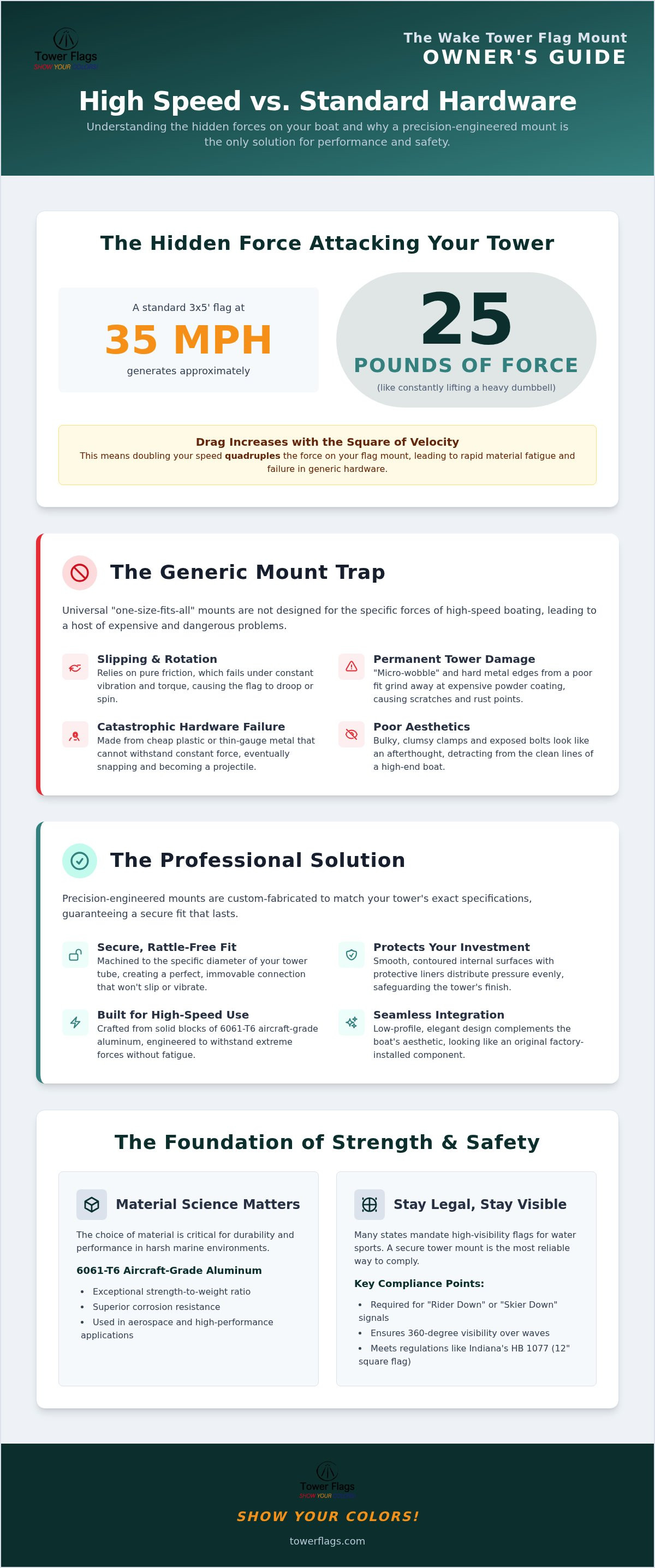
Did you know that a standard 3x5 foot flag generates approximately 25 lbs of wind force when your boat hits just 35 mph? That is a significant amount of constant pressure pulling on your tower, yet many boaters still use a generic wake surf flag mount that wasn't built for those specific loads. You've likely felt the frustration of hardware that slips under pressure or, worse, leaves permanent scratches on your expensive powder coating. It's a common problem for owners who value both high-speed performance and a professional aesthetic.
In this guide, we'll show you why a precision-engineered bracket is the only reliable solution for flying flags at high speeds. You'll discover how to achieve a secure, rattle-free fit that stands up to intense wind drag without compromising your boat's high-end look. We'll also cover how to stay compliant with evolving state safety laws, such as the 2026 Indiana House Bill 1077, by using hardware designed for the task. We'll break down the materials science behind 6061-T6 aircraft-grade aluminum and explain why custom-fit brackets are the master craftsman's choice for the modern wake tower.
Table of Contents
Understanding the Role of Flags with Towers in Modern Boating
Utilizing a wakeboard tower as a mounting point for flags is a strategic decision for visibility and safety. In modern boating, the practice of "flags with towers" refers to using the highest structural point on a vessel to display safety signals or emblems of pride. A dedicated wake surf flag mount allows the flag to clear the boat's cockpit, ensuring that other boaters can see your status from a distance. Whether you're flying a national ensign or a required safety signal, the tower provides the 360 degree exposure that seat-mounted or handheld poles simply can't match. This elevation is critical in high-traffic waterways where lower-profile flags might be obscured by waves or other vessels.
Mounting a high-drag object to a structural tower presents a legitimate engineering challenge. A standard 3x5 foot flag generates approximately 25 lbs of wind force at 35 mph. This force acts as a lever on the mounting bracket, multiplying the stress on the attachment point. Generic hardware often fails under this constant vibration and pressure, leading to slipped mounts or damaged tower finishes. Choosing a precision-engineered wake surf flag mount ensures that these forces are distributed safely across the tower's surface without causing structural fatigue or cosmetic wear. It's a shift from temporary, "universal" solutions to hardware built for marine performance.
Legal Compliance and Water Safety Awareness
Specific state laws mandate the use of "skier-down" or "water recreation" flags to signal when a person is in the water. For instance, Indiana House Bill 1077, effective July 1, 2026, requires a bright orange or red flag at least 12 inches square to be displayed when a towed person enters the water. Washington law is similarly strict, requiring a red or orange flag on a pole at least 24 inches long. Tower mounting is superior because it keeps the flag visible even in heavy chop. Unlike handheld flags, which are difficult to manage in high winds, a tower-mounted setup remains secure and visible to everyone on the water. Following proper maritime flag etiquette and legal requirements is much simpler when your hardware is designed for permanent, high-visibility placement.
The Aesthetic and Social Value of Tower Display
For owners of high-performance boats, every addition should complement the vessel's design. Mass-produced, universal mounts often look like an afterthought, using bulky clamps that scratch powder coating. Custom-fit hardware preserves the clean lines of your wake tower while providing a rock-solid attachment. There's a distinct sense of pride in having a setup that doesn't rattle or lean when you're at cruising speed. It's the difference between a temporary fix and a professional, engineered solution that matches the boat's high-end aesthetic and signals a commitment to quality craftsmanship.
The Physics of High-Speed Marine Flag Mounting
Flying a flag on a wake tower isn't just about aesthetics; it's a matter of managing mechanical stress. At cruising speeds, your flag acts as a high-drag sail. According to industry data, a standard 3x5 foot flag generates approximately 25 lbs of wind force at 35 mph. While 25 lbs sounds manageable, the physics change when you consider the flag pole's length. This creates a lever arm effect where the force is magnified at the mounting point. A four-foot pole translates that wind drag into significant torque, putting immense pressure on your wake surf flag mount.
When you install a dedicated wake surf flag mount, precision fitment is the primary defense against hardware fatigue. Inexpensive, universal hardware often lacks the structural integrity to withstand these constant loads. When a bracket isn't perfectly matched to the tower's diameter, it relies on high-friction clamping that eventually slips. This movement leads to "micro-wobble," a condition where the mount vibrates against the tower thousands of times per minute. This cycle of stress and movement is what causes catastrophic hardware failure and unsightly damage to your tower's powder coating.
Drag Forces and Material Stress at 30+ MPH
The math of wind resistance is unforgiving because drag increases with the square of your speed. If you double your velocity, the force on the flag doesn't just double; it quadruples. High-speed drag translates into rotational torque on the mounting bracket, attempting to twist the hardware around the tower tube. Most generic plastic or thin-gauge metal mounts aren't rated for these stresses and will snap or deform under the load. Choosing high-performance flag pole brackets ensures your setup remains vertical even when the wind resistance is at its peak.
Vibration Dampening and Tower Integrity
Marine environments are notoriously harsh due to constant engine resonance and hull chop. These vibrations travel through the tower and look for the weakest link in your hardware. Using high-quality marine-grade materials like 6061-T6 aluminum allows the mounting system to absorb and dissipate this energy rather than vibrating loose. Precision-fabricated mounts eliminate the metal-on-metal grinding common in universal clamps by providing a total-contact fit. This exactness prevents the hardware from "walking" down the tower or chewing through the protective finish, maintaining your boat's structural and cosmetic integrity over years of use.
Why Custom-Fit Brackets Outperform Universal Mounts
Choosing the right hardware for your vessel often comes down to a choice between convenience and engineering. Many mass-market retailers promote universal clamps as a one-size-fits-all solution, but this philosophy rarely holds up in a marine environment. A universal wake surf flag mount is designed to fit a wide range of diameters, which means it doesn't actually fit any of them perfectly. Instead of a secure mechanical bond, these mounts rely on friction and compression, often leading to failure when subjected to high-speed wind drag. For the serious boater, custom-fit hardware is the only way to ensure total security.
The Problem with One-Size-Fits-All Clamps
Universal kits typically include a bag of rubber spacers or plastic shims to fill the gap between the bracket and your tower. These components are the weakest link in the system. Under the heat of the sun and the constant pressure of wind force, rubber spacers compress and lose their elasticity. This creates a small amount of play that quickly turns into a significant wobble. Once the mount starts to move, it acts like sandpaper against your tower's finish. We've seen countless examples of expensive powder coating ruined by "convenient" universal hardware that wouldn't stay in place. It's a frustrating cycle of tightening and re-tightening that distracts from your time on the water.
Precision Engineering for Specific Tower Geometries
Custom fabrication eliminates these variables by matching the exact diameter and arc of your tower. Whether you are running a Malibu G3, G5, or another high-end structural tower, a precision-machined bracket provides a total-contact fit. This design distributes the torque and drag forces evenly, preventing the localized stress points that cause tower damage. It's truly a "set it and forget it" solution. You won't find yourself reaching for a hex key after every run because the hardware is physically incapable of slipping.
Ensuring your flag stays upright is also a matter of safety and compliance. When you look at FWC flag regulations, the emphasis is on maintaining visibility so other boaters can identify your status. A stable mount ensures your safety signal remains unfurled and clear to everyone in the vicinity. For more technical details on how these brackets are manufactured for specific boat models, check out The Ultimate Guide to Custom Boat Flag Brackets 2026. This precision approach is the hallmark of American-made quality, providing the reliability that mass-produced imports simply can't match.
Best Practices for Secure Wake Tower Flag Attachment
Securing a flag to a wakeboard tower requires more than just finding an open spot on the tubing. It is a process that demands an understanding of the boat's functional zones. To start, you must identify a mounting point that offers maximum visibility without interfering with the boat's essential operations. The optimal location is typically on the upper horizontal bar or the rear-facing vertical supports. This ensures the flag sits high enough to be seen by other vessels from 360 degrees, which is a core safety requirement on crowded lakes. Before you finalize the position of your wake surf flag mount, you should simulate the flag's movement at speed to ensure it won't strike your speakers or wrap around the tow point.
Flag wrapping is a common frustration that renders safety signals useless. When a flag wraps tightly around the pole, it loses its profile and becomes invisible to other boaters. To prevent this, avoid using rigid attachments like zip ties or tape. Instead, utilize high-quality swivel clips or adjustable collars that allow the flag to rotate independently of the pole. This freedom of movement ensures the flag remains unfurled regardless of wind direction, maintaining your vessel's compliance with safety laws while reducing the rotational torque applied to the mounting hardware.
Optimizing Placement for Visibility and Clearance
Placing your mount above the tow point is the most effective way to ensure "rider down" signals are seen immediately. If the flag is tucked away behind board racks or obscured by large tower speakers, you're compromising the safety of everyone in the water. A high, unobstructed position is the master craftsman's standard for a professional setup. You should also consider the path of the tow rope during sharp turns to ensure the flag pole doesn't snag the line. For many boat owners, achieving aesthetic symmetry is also a priority, often leading them to install a pair of brackets to balance the visual lines of the tower. For hardware that stays secure without constant adjustment, explore our professional-grade flag pole brackets.
Routine Inspection and Hardware Maintenance
The marine environment is notoriously hard on mechanical attachments. Constant engine resonance and hull chop can act as a slow hammer on your hardware, making routine inspections a necessity. Before every launch, you should perform a quick safety check of your wake surf flag mount.
Verify the bolt torque to ensure nothing has vibrated loose during transport.
Inspect the tower surface for any signs of movement or finish wear.
Rinse the brackets and poles with fresh water after each outing to remove salt spray or mineral deposits.
Examine the flag pole for any hairline stress fractures, especially if you frequently cruise at high speeds.
Taking five minutes to confirm the structural integrity of your setup prevents catastrophic failures and ensures your equipment remains as reliable as the day it was installed.
Choosing a Durable Marine Flag Solution
Selecting a durable mounting solution is about more than just finding a metal bracket that fits your tower's diameter. It is a strategic investment in materials that can survive the corrosive cocktail of intense UV rays, constant salt spray, and high-velocity wind. For the discerning boat owner, a wake surf flag mount must be as resilient as the vessel it is attached to. Choosing between high-end marine alloys and standard retail hardware is the difference between a permanent, professional installation and a temporary fix that will eventually fail under the stresses of the open water.
The marine environment is notoriously unforgiving to inferior metals. While many big-box retailers offer "universal" kits made from thin-gauge steel or plastic, these materials lack the structural integrity required for high-speed performance. Professional-grade hardware relies on specialized fabrication techniques that prioritize longevity and mechanical efficiency. By choosing a solution designed by specialists, you eliminate the common frustrations of rattling, oxidation, and hardware fatigue that plague generic alternatives. It's about finding a product that reflects the high-end aesthetic of your boat while delivering the rugged performance you expect on every outing.
Material Selection: Performance and Longevity
When comparing hardware, the choice often comes down to the specific properties of the metal used in the build. While 316L stainless steel offers superior corrosion resistance, it often carries a 25 to 50 percent price premium over 304 stainless steel, a cost that is frequently justified in saltwater environments. However, many master craftsmen prefer specialized marine alloys like 6061-T6 aircraft-grade aluminum for a wake surf flag mount because of its incredible strength-to-weight ratio. "Marine-grade" isn't just a marketing buzzword; it's a technical requirement that ensures your hardware won't pit, peel, or lose its structural integrity when subjected to constant engine resonance. To learn more about the technical specifications of these materials, see Marine Flag Poles: Engineering for Durability and High-Speed Performance.
The Tower Flags Difference: Precision Fabrication
Tower Flags operates as a dedicated workshop focused on custom-engineered excellence. We reject the "one-size-fits-all" approach because we know that every wake tower has unique geometries that require a precision fit. Our American-made manufacturing process ensures a level of quality control that mass-produced imports simply cannot replicate. This specialized focus eliminates the "frustration factor" for boat owners by providing hardware that installs easily and remains rock-solid at any speed. We take pride in the fit and finish of every piece, ensuring it matches the clean lines of modern towers from Malibu, MasterCraft, and other top-tier manufacturers. If you're ready to upgrade your vessel with hardware built for the long haul, we invite you to explore our custom flag pole brackets and high-performance flag poles today.
Elevate Your Vessel with Precision Engineering
Securing a flag to your boat should never be a matter of guesswork or temporary shims. As we've explored, the physics of high-speed travel demand a wake surf flag mount that is engineered for stability and tower protection. By moving away from universal clamps and embracing custom-fit fabrication, you eliminate the mechanical failures and cosmetic damage that plague generic hardware. A professional setup ensures that your safety signals remain visible and your tower remains pristine, regardless of the wind drag or engine resonance you encounter on the water.
Investing in American-made marine hardware provides the reliability that serious boaters require. Our solutions are high-speed performance tested and custom-fit for major tower brands, ensuring a seamless aesthetic that matches your vessel's high-end design. It's time to stop adjusting slipping brackets and start enjoying a rattle-free experience. Shop Precision-Engineered Custom Boat Flag Brackets today to find the perfect specialized solution for your boat. Experience the confidence that comes from hardware designed by craftsmen who prioritize integrity and exactness above all else.
Frequently Asked Questions
Is it better to mount my flag on the wake tower or the hull?
Tower mounting is superior for both visibility and safety. Hull mounts are low-profile and often obscured by waves or the boat's cockpit, making them difficult for other vessels to see. Elevating the flag on the tower ensures 360 degree visibility, which is essential for "rider down" signals. While hull mounts avoid wind drag issues on the tower, a precision-engineered wake surf flag mount handles those forces easily, providing a safer display for high-traffic waterways.
Can I fly a 3x5 flag on my wakeboard tower at full cruising speed?
You can fly a 3x5 flag at speed only if you use specialized, high-strength hardware. A flag of this size generates roughly 25 lbs of wind force at 35 mph, creating significant torque on the mounting bracket. Standard flagpoles and universal plastic mounts often snap or slip under these conditions. For full cruising speeds, you must utilize a custom-fit bracket and a reinforced pole rated for high-velocity marine environments to prevent catastrophic hardware failure.
How do I prevent my flag mount from scratching my tower’s powder coating?
Preventing scratches requires a precision-fit bracket that eliminates all movement. Universal mounts often use rubber spacers that compress over time, allowing the metal bracket to rub against the tower. This friction eventually destroys your powder coating. A custom-fabricated mount matches the exact diameter of your tower tubing, providing total surface contact. This tight mechanical bond prevents the micro-wobble that causes finish wear, ensuring your tower remains in pristine condition for years of use.
What is the best material for a high-speed boat flag pole?
High-strength marine alloys like 6061-T6 aluminum or 316-grade stainless steel are the industry standards. These materials offer the best weight-to-strength ratio, which is critical when facing the lever-arm effect of wind drag at 30 mph or faster. While stainless steel is excellent for corrosion resistance, specialized aluminum alloys provide the rigidity needed to prevent the pole from whipping or bending. You should avoid thin-walled plastics or generic fiberglass poles as they lack structural integrity.
Do I need a special mount for a Malibu G3 or G5 tower?
Yes, these towers have specific geometries that require custom-engineered brackets for a secure fit. Because Malibu G3 and G5 towers don't use standard round tubing, a universal wake surf flag mount will almost certainly slip or cause damage. We manufacture brackets designed specifically for these unique profiles, ensuring the hardware follows the tower's arc perfectly. This specialized fitment is the only way to achieve a rattle-free, professional look that matches your boat's high-end aesthetic.
What happens if my flag mount vibrates loose while towing a rider?
A loose mount creates a significant safety hazard by distracting the driver and potentially dropping the flag into the propeller or the tow line. If the hardware fails while a rider is in the water, you lose your primary signal for other boaters, which can lead to legal violations and dangerous close-calls. This is why we prioritize high-torque fasteners and custom-fit designs that resist engine resonance and hull chop, keeping your safety signals secure at all times.
Are there specific laws about how high a rider-down flag must be?
Most state laws focus on visibility rather than a specific height measurement, though tower mounting is the most effective way to comply. Regulations in states like Indiana and Washington require safety flags to be visible from all directions when a person is in the water. By placing the flag at the highest point of your boat, you ensure that even larger vessels can see your status over waves and wake, fulfilling the safety requirements of the law.
How do I choose the right clamp size for my aftermarket wake tower?
You must measure the exact outside diameter of your tower tubing using a set of calipers. Aftermarket towers vary significantly, and even a fraction of an inch difference can cause a mount to fail. Avoid using "close enough" measurements with a tape measure. Once you have the precise diameter, select a bracket fabricated to that specific size. This ensures the mount makes full contact with the tubing, providing the stability needed for high-speed marine environments.


Comments