

US Coast Guard Flag Regulations: What Boaters Need to Know in 2026
A Coast Guard flag policy isn’t automatically a rule for your private boat. That distinction matters: the Coast Guard’s November 2025 policy prohibits divisive or hate symbols on Coast Guard workplaces, facilities, and assets, but it doesn’t by itself set flag rules for every recreational vessel. Before raising a flag, identify which guidance applies and verify it against a current, authoritative source.
This guide explains how US Coast Guard flag regulations differ from civilian boating etiquette and policies for Coast Guard personnel. You’ll learn what private boaters should verify, where official requirements may come from, and how to display a U.S. or Coast Guard-related flag thoughtfully. We’ll also cover practical considerations for secure flag mounting, while keeping hardware choices separate from legal compliance. The goal is to help you identify the rules that fit your situation and make an informed choice on the water.
Table of Contents
What do US Coast Guard flag regulations cover?
The phrase US Coast Guard flag regulations can refer to official service policy, flag etiquette, or rules that govern vessels. These are different kinds of guidance, with different audiences and authority. A policy for Coast Guard personnel shouldn’t be treated as a rule for a privately owned recreational boat unless an applicable legal source says it covers that boat.
Start with scope: who must follow the instruction, where does it apply, and what source establishes it? A federal requirement may be legally enforceable within its stated jurisdiction. A service directive sets expectations for Coast Guard personnel. A flag custom can guide respectful display without carrying the force of law. Keeping these categories separate helps prevent a news headline from sounding broader than the policy it describes.
What the 2025 Coast Guard policy announcement says
A November 20, 2025, Department of Defense press release announced Coast Guard personnel policy concerning the display, distribution, or use of divisive or hate symbols and flags. It described the policy’s scope as Coast Guard workplaces, facilities, and assets, and named categories such as symbols associated with hate groups. The release also stated a prohibition on the Confederate battle flag, with exceptions described for state flags and certain educational or historical displays.
The November 20, 2025, announcement addresses Coast Guard personnel and Coast Guard workplaces, facilities, and assets; it does not, by itself, establish a flag rule for every private boat.
This describes the audience boundary, not every detail of the policy. A press release is a summary. For a specific situation, consult the complete policy or directive for its terms, exceptions, and enforcement. Don’t rely on a headline or repost to determine what conduct is covered.
Why private boaters should separate policy from etiquette
Federal regulations and statutes can create binding requirements when they apply to a person, vessel, or activity. Coast Guard service directives govern the service’s personnel and operations within their stated scope. Customs, such as where a flag is traditionally displayed, can offer useful guidance, but custom alone doesn’t establish a legal obligation. Before calling a display illegal, identify an authoritative legal source that applies to the boat and circumstances.
Flag identity matters, too. The U.S. national flag represents the United States; the Coast Guard ensign is a distinct service flag associated with the Coast Guard. They aren’t interchangeable simply because both use familiar national symbols. The Flag of the United States Coast Guard Wikipedia page offers historical context and a description of the ensign, but it isn’t a legal authority. For a flag decision aboard a private vessel, first identify which flag you mean, then consult the current rule or etiquette source relevant to your situation.
How Coast Guard personnel flag policy differs from civilian boating guidance
The answer to a flag question can depend on who is displaying it and why. A Coast Guard personnel order, an Auxiliary procedure, and a recreational boater’s flag choice don’t automatically share the same scope. Use the comparison below to identify the source that applies before treating guidance as a rule.
Which rules apply to Coast Guard personnel?
The November 20, 2025 announcement concerns Coast Guard personnel and a policy addressing the display, distribution, or use of prohibited symbols. Its summary identifies workplaces, facilities, and assets, but a summary can’t settle every edge case. Consult the original Coast Guard release and follow its link to the full policy for exact wording, exceptions, and who is covered. Don’t assume the order automatically extends to contractors or Auxiliary members; verify their status and applicable instructions in authoritative sources.
Keep two subjects separate. A policy about prohibited symbols governs conduct within its defined scope. Rules about a service flag’s position, display, or ceremony may come from different service guidance. Federal regulations in eCFR Title 33 Part 23 address distinctive marks for Coast Guard vessels and aircraft, including the ensign and commission pennant. That source concerns Coast Guard vessels and aircraft, not a general flag-placement manual for private boats.
What should private boaters verify separately?
For a recreational vessel, check the current federal navigation rules and any vessel-specific requirements that apply to its operation. Then consider whether state or local requirements matter for the boat’s location or activity. A rule may govern navigation or required equipment rather than a flag’s courtesy or position, so confirm the subject as well as the audience before applying it.
An internal Coast Guard order governs only the people and settings within its stated scope; private boaters should follow requirements that independently apply to their vessel and circumstances. This distinction keeps a service policy from being mistaken for a universal civilian rule. It also avoids the opposite mistake: assuming every flag custom is legally required, or that no legal requirement could apply.
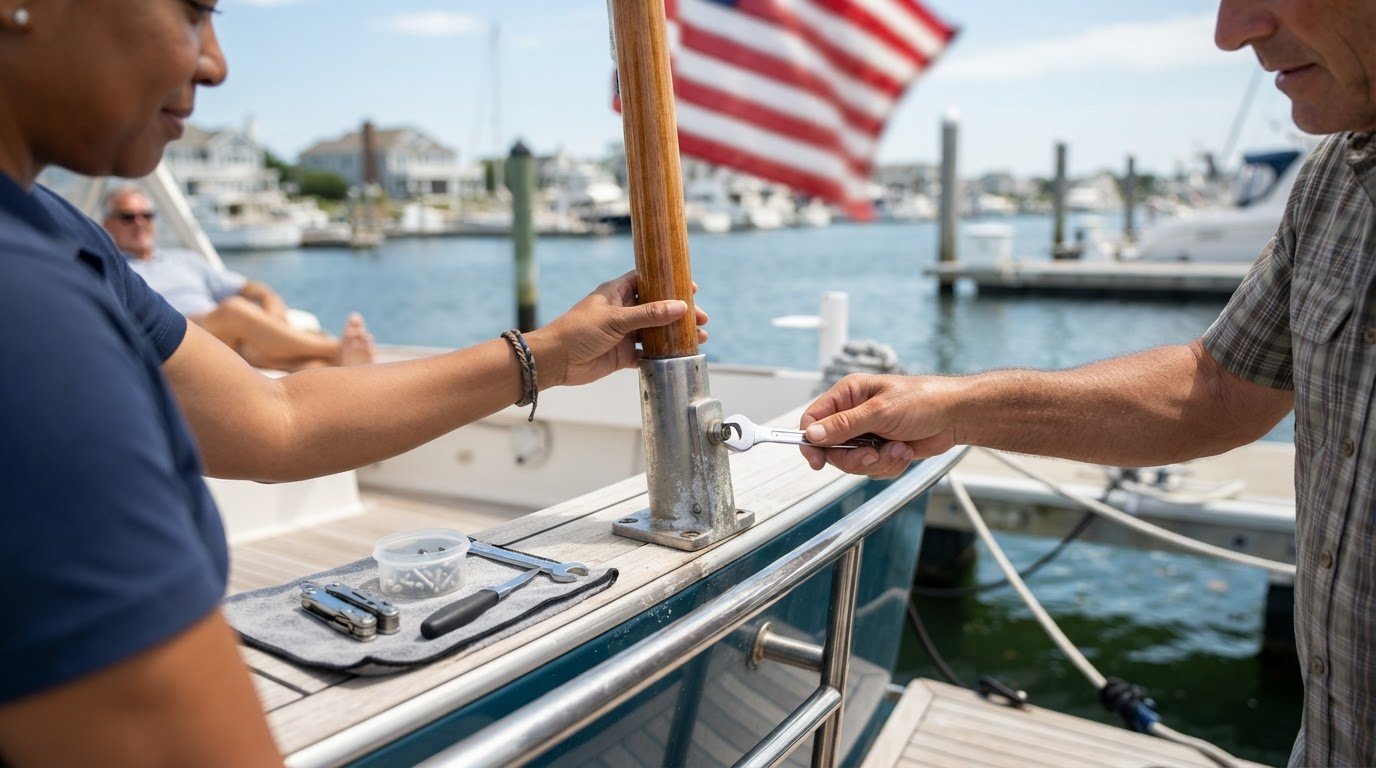
Separate flag selection from the mechanics of display. A U.S. national flag, a Coast Guard ensign, and an Auxiliary flag aren’t interchangeable. Once you’ve identified the appropriate flag and guidance, secure mounting hardware can help keep the display stable aboard your vessel. Custom boat flag brackets and poles offer a purpose-built option for that practical part of the setup, but hardware doesn’t determine legal compliance.
Which Coast Guard flag display claims are law, policy, or etiquette?
Flag guidance is easier to interpret when you classify it before deciding what to do. A statement may describe a legal requirement, an internal agency policy, or a customary practice. These labels aren’t interchangeable, and the same display may be treated differently depending on the flag, audience, vessel, and circumstances. When researching US Coast Guard flag regulations, identify the source and its scope before treating advice as a mandate.
Binding rule: A statute or regulation may create a legal requirement for the people, vessels, or activities it covers. Look for the issuing authority, citation, and language that establishes the duty.
Agency policy: A Coast Guard directive or order may set expectations for personnel or agency operations. Its reach depends on the document’s terms; don’t assume it governs private boaters.
Customary etiquette: A convention can guide respectful flag display without necessarily being legally enforceable. Unless an applicable authority makes a practice mandatory, describe it as custom or advice.
How to tell a regulation from a custom
Read the source, not just the headline. Check who issued it, whether it cites a statute or regulation, who it addresses, when it took effect, and what its operative wording requires. “Must” or “is required to” can signal a duty, but the surrounding text still determines who has that duty. “Should,” “customarily,” or “is encouraged” generally points to guidance, not a standalone legal command.
If sources seem to conflict, pause rather than filling the gap with an assumption. A retailer summary or social post may omit an exception or apply a rule to the wrong audience. Find the current primary document, then compare its scope with the specific display in question.
What the U.S. Flag Code can and cannot establish
The United States Flag Code, in Title 4 of the U.S. Code, sets out guidance and standards concerning respect for and display of the U.S. flag. Its provisions can help explain national-flag etiquette, but they shouldn’t be treated as proof that every suggested practice is a legally enforceable requirement for a private boater. The Code itself doesn’t impose penalties for civilian noncompliance. A separate applicable law may still address particular conduct, so assess that law on its own terms.
Keep the subject precise. Guidance for the U.S. national flag doesn’t automatically govern a Coast Guard ensign, Auxiliary flag, or Coast Guard personnel policy. Likewise, a service policy about prohibited symbols doesn’t establish the proper position or ceremony for a civilian vessel’s flag. Verify each claim against a current, authoritative source that covers the flag, audience, and situation at hand.
How to verify current US Coast Guard flag regulations
A reliable check starts with the source, not the search result summary. Headlines can blur the distinctions between personnel orders, vessel regulations, and voluntary flag customs. Use these steps to trace a claim to its authority and decide whether it applies to your situation.
A four-step check before relying on a flag rule
Identify the audience. Determine whether the guidance is for Coast Guard personnel, Auxiliary members, or private boaters. Don’t assume a rule written for one group covers another.
Locate the primary source. Find the original Coast Guard directive, federal regulation, or official guidance document. Treat retailer summaries, news reports, and reposts as starting points, not final authority.
Check its date. Review the publication date, revision history, and any stated effective date. A page may remain searchable after its guidance has changed or been replaced.
Confirm the scope. Match the document’s terms to the vessel, flag, activity, and circumstances at issue. A rule about a Coast Guard vessel, for example, may not answer a question about a private recreational boat.
What to do when sources appear to conflict
Compare complete primary documents rather than relying on a headline or an isolated sentence. Note which source is newer, then check whether it explicitly revises, supersedes, or withdraws earlier guidance. A newer publication date alone doesn’t prove that one document replaces another; look for that relationship in the text or its official revision record.
If the original document links to a policy or order, follow the link and read the operative language, definitions, exceptions, and any stated limits. Keep a record of the source title and date you reviewed. That makes it easier to revisit the question if the Coast Guard or another authority updates its guidance.
Verification note: The November 20, 2025, announcement concerned Coast Guard personnel policy. Before relying on a claim about its current wording, effective status, or reach, check the current Coast Guard release and the full linked policy. If an official document is unavailable or its scope remains unclear, don’t present an interpretation as a settled rule.
Use current Coast Guard documents for service policy and applicable federal regulations for legal requirements. If a claim concerns state or local restrictions, verify it with the relevant government source as well. A flag etiquette guide can help with customary display, but it isn’t a substitute for a regulation when the question is legal.
Once the flag and applicable guidance are clear, treat mounting as a separate practical decision. For vessel-specific considerations, consult this durable boat flag hardware guide. To plan a secure display, explore custom boat flag brackets and poles. Hardware supports the physical setup; it doesn’t determine whether a flag display complies with a rule.
How to display a Coast Guard or U.S. flag responsibly on a boat
A thoughtful display starts with two separate decisions: which flag belongs in the setting, and how to mount it securely. Etiquette can guide placement and respectful handling, but treat it as custom unless an authoritative source makes a particular practice mandatory. The US Coast Guard flag regulations that apply to Coast Guard personnel shouldn’t be mistaken for a universal display rule for private vessels.
Choose the flag and display context carefully
First identify the flag. The U.S. national flag, Coast Guard ensign, and Coast Guard Auxiliary ensign are distinct flags with different meanings. Flying a service flag on a privately owned boat doesn’t, by itself, establish Coast Guard affiliation or official status. If that distinction could be unclear to observers, choose a flag that accurately reflects your purpose.
For placement and display customs, consult current official or recognized boating and flag-etiquette guidance. Common U.S. flag etiquette places the national ensign at the stern of a motorboat; on a sailboat, customary positions include the gaff peak or leech of the aft-most sail. Daytime display, traditionally from 8:00 a.m. to sunset, is also described as custom. Verify the guidance and its context, and don’t present these conventions as legal duties unless an applicable authority says they are.
Secure mounting is a separate boating consideration
After choosing the flag and its position, assess the physical setup. Consider the vessel’s structure, mounting location, access for raising and lowering the flag, and expected operating conditions. A location that works at rest may create clearance or interference concerns underway. Inspect the attachment and flag periodically, especially after exposure to conditions that could loosen or wear components.
Custom marine flag brackets and poles provide hardware for securing a display aboard a vessel, but no bracket makes a flag choice legally compliant or suitable for every boat. Fit and mounting depend on the vessel and intended position. The custom boat flag bracket guide explains mounting options to consider as you plan the physical setup.
Keep the sequence straightforward: identify the flag, confirm the relevant rule or etiquette guidance, choose an appropriate position, then secure the mounting. That separation helps prevent a practical hardware decision from being mistaken for a regulatory one. For a vessel-specific flag setup, explore custom marine flag brackets and poles from Tower Flags.
Make your next flag choice with confidence
Before changing a display, make one deliberate check: does the guidance address your boat and situation, or a different audience? This helps keep US Coast Guard flag regulations, civilian requirements, and voluntary customs in their proper lanes. Once you’ve settled the flag and placement, give equal care to the physical setup. A secure mount supports a well-considered display, though it doesn’t determine whether that display meets a rule.
Tower Flags designs and manufactures custom marine flag brackets and poles, with a focus on boat-specific mounting hardware. If you’re planning a setup for your vessel, explore custom flag mounting options and take the next step toward a thoughtfully chosen, securely mounted display.
Frequently Asked Questions
Do US Coast Guard flag regulations apply to private boats?
Not automatically. A Coast Guard personnel policy applies according to its stated scope, while requirements for a private vessel must come from a rule that actually covers that vessel or its activity. For example, a display custom in a boating guide isn’t automatically a federal requirement. Check the relevant federal, state, or local source before deciding whether a specific flag or use is regulated.
Can civilians fly a Coast Guard flag on a boat?
Don’t assume that displaying an official Coast Guard ensign is unrestricted. Federal rules in 33 CFR Part 23 address distinctive Coast Guard marks and restrictions on unauthorized use. Check the current regulation and any applicable authorization before flying an ensign that could suggest official status. A decorative or commemorative flag may raise different questions, so identify exactly what the design represents rather than relying on a product description alone.
What is the difference between a Coast Guard ensign and the U.S. flag?
The U.S. flag is the national flag; the Coast Guard ensign is a separate flag associated with the Coast Guard and its official functions. They have different designs and meanings, so one shouldn’t be used as a substitute for the other. If a flag’s appearance or wording could imply an official connection, verify its identity and any restrictions before displaying it on a privately owned vessel.
What did the Coast Guard announce about flags in November 2025?
On November 20, 2025, the Coast Guard announced a personnel policy prohibiting divisive or hate symbols and flags in Coast Guard workplaces, facilities, and assets. The announcement also addressed the Confederate battle flag, with described exceptions for state flags and certain educational or historical displays. To assess a specific case, read the full policy linked from the original announcement; a press release may not include every definition or exception.
Is the United States Flag Code legally binding for private boaters?
The Flag Code provides guidance on respect for and display of the U.S. flag, but it doesn’t impose penalties on civilians simply for failing to follow its recommendations. That doesn’t settle every situation: separate federal, state, or local laws may apply to particular conduct or locations. Treat customary flag practices as etiquette unless a relevant legal source makes a specific requirement binding for your circumstances.
How can I check whether a Coast Guard flag policy is current?
Start with the original Coast Guard announcement, then open the full directive or policy it references. Look for a revision history, effective date, and language saying whether an earlier version was replaced. For vessel rules, search the current federal regulation rather than relying on a copied excerpt. If a page lacks a date or links only to secondary summaries, keep looking for the issuing authority’s current document.
What happens if a private boater displays a flag incorrectly?
There isn’t one consequence for every display mistake. An etiquette departure alone doesn’t necessarily create a legal penalty, but unauthorized use of protected Coast Guard marks or conduct covered by another applicable law can raise separate issues. The outcome depends on the flag, the way it’s used, and the governing rule. If you spot a possible problem, identify the specific source before assuming a violation or a penalty applies.
Comments